Every authority, green-tick verified.
Cases checked against Find Case Law (or BAILII); Acts against our list of UK Acts. Anything that can't be confirmed is flagged for you to check before you rely on it.
Give it a matter and it works the file the way you would — runs the ID, AML and conflict checks, drafts the client-care letter and the first version, finds the precedent, and tracks every deadline to the day. You review and sign off. It never advises; you stay the supervising solicitor.
Early access · 30% off, locked 12 months · SRA-aligned audit trail
Built with input from UK solicitors·UK data centres·Solicitor-supervised by design
100%
AI output signed off by a solicitor — never the AI
0
of your client data is used to train AI models
6yrs
Audit trail kept — the SRA's retention period
100%
Citations checked against the official source
The product, unscripted
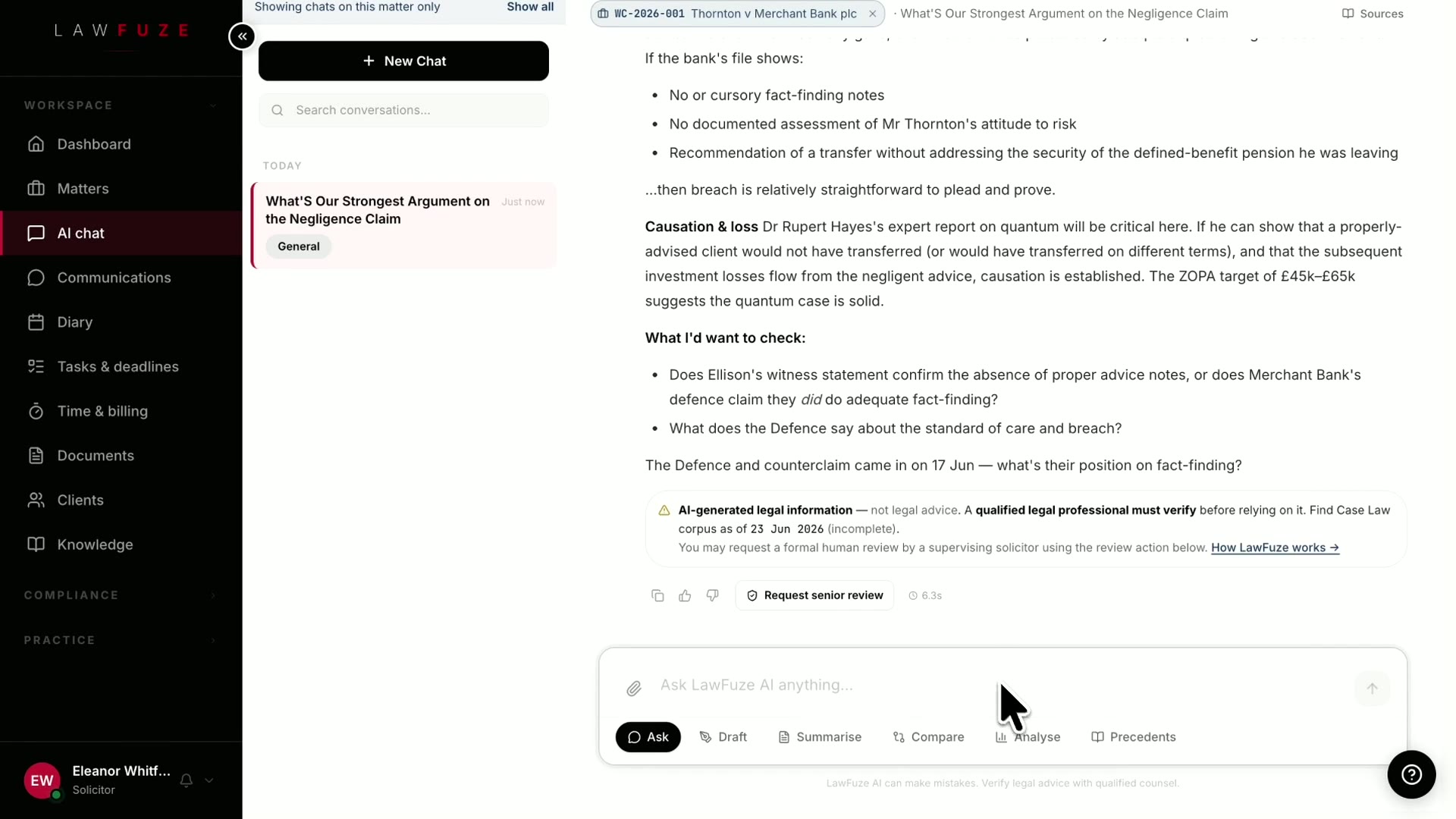
One real matter, worked inside LawFuze — no slides, no mock-ups. You sign off every output before it leaves the firm.
A co-worker that thinks like a lawyer
Ask in plain English — get a grounded, cited answer, flagged for a solicitor to verify before you rely.

Actual product UI · illustrative matter with fictional names & data
What only LawFuze does
Legal AI today comes in three shapes: general chatbots hosted in the US, enterprise suites priced for the largest firms, and single-task drafting add-ins. Each leaves a gap a UK solicitor has to cover. Here is what they miss — and where LawFuze is built to fit.
UK-hosted data
Every matter, document and search index is stored in UK data centres. Your COLP can see exactly which suppliers process client data, and where.
What competitors doUS tools offer EU residency at best. UK case-management systems often run on shared US/UK clouds.
Supervisor sign-off
Nothing the AI drafts reaches a client unless a solicitor sends it. Answers the citation and grounding checks flag go to a supervisor's review queue, and each sign-off is logged with the solicitor's SRA number. As a solo practitioner, you are the supervisor — and your sign-off is logged in exactly the same way.
What competitors doMany tools treat the lawyer as a single user, with no sign-off step in the workflow.
Official case law
Case law comes from The National Archives' Find Case Law, the official record. Every case cited in a draft is checked against it (or BAILII) and every Act against our list of UK Acts before export; anything that can't be found is flagged, and firms can choose to block the export.
What competitors doFree indexes are unofficial mirrors. US tools are US-only. Pan-European tools treat UK case law as an afterthought.
Rule-cited deadlines
For each matter, LawFuze works out the key deadlines and attaches the applicable Civil, Family or Criminal Procedure Rule to each one — so every date carries the rule it comes from.
What competitors doUK case-management ships static templates. Single-purpose drafting tools don't model deadlines. Generic calendars carry no rule citation.
UK pricing
£499/month for a firm of up to five fee-earners, and £149/month for a sole practitioner — published prices, not a sales quote.
What competitors doEnterprise legal-AI is quote-only and built for the largest firms. Single-purpose drafting add-ins solve one slice of the work.
SRA-bound AI
Most legal AI runs your matter through a model whose terms quietly reserve the right to keep your data. LawFuze pins the AI to the SRA Code itself — confidential by design, supervised by default, and built so no third party ever trains on what you're working on.
What competitors doGeneric AI terms reserve broad re-use rights for 'service improvement'. The vendor isn't bound by your professional code — you are. LawFuze holds the AI to it too.
Ten early-access firms. 30% off, locked for 12 months. The founders answer the email.
LawFuze reads the whole file, computes the numbers that matter by rule not by guess, and verifies every authority before it leaves the building. You stay accountable; the AI assists, and every decision is auditable.
Every case in a draft is checked against The National Archives' Find Case Law (or BAILII), and every Act against our list of UK Acts. Anything that can't be found is flagged for your sign-off before export, and firms can choose to block it. The post-Ayinde duty, built into every draft.
Limitation and court deadlines are worked out by fixed legal rules — not estimated — each citing its rule, with reminders 7, 3 and 1 day before.
Each significant automated decision is recorded in a tamper-evident DUAA 2025 log — the inputs, the output and the lawful basis — and a named solicitor can review and override it. Your audit trail writes itself.
From source-of-funds reconstruction to disclosure review, LawFuze reads the entire file and pins every figure and clause to its source document. It surfaces the gap a tired human skims past — it never makes one up.
SDLT, limitation, IHT relief and quantum are calculated by fixed, traceable rules. Every number traces back to a rule and a source — no guesswork on the figures that matter.
Before a single line of firm data reaches any AI, it's checked for legal professional privilege and personal data — and recorded in an AI usage log the COLP can search. The firm can prove, on demand, every time client data touched AI, what it held, and the named fee-earner. The outgoing text is never stored — only a fingerprint of it.
Capacity prompts never label a client. SARs are drafted, never filed. The AI does the work; the solicitor makes the call — always.
The tools behind it · one accountable workspace
Verify & audit
Deadlines & money
Risk & conduct
Litigation & property
The 60-minute intake
A new client at a typical UK firm takes 24 days from first contact to billable work — most of it admin, all of it regulated. LawFuze runs the whole sequence in one supervised AI flow. 20 minutes of fee-earner time, end-to-end.
The prospect tells the AI what happened. Multi-turn, refuses legal advice, classifies practice area, identifies parties, estimates fee band.
DUAA 2025 s.80 — notice + contest baked in
Every party is checked against every matter the firm has run, open and closed — names normalised and linked through shared emails, phone numbers and company domains. The solicitor decides every match.
SRA Code 6.1–6.2 — conflicts of interest
Client photographs their passport + a selfie on their phone. eIDV (Onfido via Thirdfort) — coming at public launch; PG81 Safe-Harbour aligned.
MLR 2017 reg.28 — customer due diligence
Open Banking one-tap consent — statements reviewed, narrative drafted, lawyer approves. Coming at public launch.
MLR 2017 reg.28(11) — source of funds verification
Drafted from your firm's template for the matter type, with the fee basis and costs estimate.
SRA Code 8.6 + 8.7 — costs information + plain English
The client pays money on account into the firm's own client account at a bank or building society. LawFuze never holds or moves client money.
SRA Accounts Rules 3–4 — your own client account
The matter opens with the workflow for its case type, ready for the first steps.
Case-type workflow — CPR, FPR, conveyancing and more
1 of 7 playing
The Ayinde defence
Ayinde v Haringey [2025] EWHC 1383 (Admin) made hallucinated authorities a referable SRA matter. We built three defences directly into the platform so every output can be checked before anyone relies on it.
Cases checked against Find Case Law (or BAILII); Acts against our list of UK Acts. Anything that can't be confirmed is flagged for you to check before you rely on it.
Priya Shah
Reviewed · 14:32
Every AI output is stamped with the regulated solicitor whose name carries it. No anonymous outputs leave the firm.
14:31:08prompt
Draft position statement on conduct
14:31:24response
AI draft generated · 3 citations
14:31:24verify
Citations green-tick passed
14:32:01review
Priya Shah · approved · note added
Hash-chained, so a later change to the record can be detected. Pull up any AI decision's inputs and output during a regulator audit.
When the SRA authorised Garfield.Law in May 2025 it stressed named, accountable solicitors and quality checks, and treated AI-proposed case law as high-risk. LawFuze keeps a named solicitor on every AI step and checks every citation against official sources before anyone relies on it. Read the methodology.
Compliance lives in the background
About one in five compliance officers told the SRA's 2025 review of the COLP and COFA roles that they were short of resources and overloaded. LawFuze keeps the COLP's registers current and runs the COFA's pre-bill time audit, so year-end is a review, not a reconstruction.
Compliance Officer · Legal Practice
Every flagged AI output lands in your queue with the named supervising solicitor pre-filled. The PII renewal pack, lateral- hire conflict check, weekly regulator digests, ongoing CDD schedule (MLR 2017 reg 27) and SRA 8.3-8.4 complaints register are all auto-prepared from your own records.
Compliance Officer · Finance & Admin
The pre-bill time audit catches what a paying party challenges on assessment (CPR 47) — missing or vague narratives, round-number entries, paralegal time at solicitor rates and overlaps — before the bill goes out. LawFuze doesn't hold your client account or its ledger; reconciliations (at least every five weeks, SRA Accounts Rules 8.3) stay in your accounts system.
For the COLP and COFA roles under the SRA Authorisation of Firms Rules (rule 8.5). See the full compliance suite.
Capabilities · live in early access
Six capabilities live in the early access. Three more turn on at public launch at public launch.
Phase 2
Pricing · early access
LawFuze is in paid pre-release for a limited number of UK firms ahead of public launch. Early-access firms get the full platform today at 30% off their tier — invoiced quarterly, no card required — with that price locked until 12 months after public launch. Each tier includes a monthly AI-token allowance pooled across your whole firm — you only ever see overage if the firm goes beyond it.
Ten early-access seats — invoiced quarterly by bank transfer, no card on file. Prices exclude VAT. Stripe self-serve billing and VAT invoicing go live at public launch.
Ten UK early-access firms are joining the paid pre-release — 30% off their tier, invoiced quarterly, with that price locked for 12 months from public launch.
Get Early Access